What sub-24 does to a hundred-miler
When we run 100 miles, is it the cutoff we’re chasing or is it an arbitrary number? We all have goals and targets when we race but there is one that stands out in the data.
We’ve all been there, dying on our feet, trying to run mental maths that takes an eternity. The brain fog of 85 miles has turned our synapses to mush. But we realise we can still hit a goal. And boom, somewhere in us a furnace fires back up and we’re running again chasing down an arbitrary number.
Twenty-four hours means nothing to a hundred mile race. The distance doesn’t change at midnight. The terrain doesn’t change. In most races your eligibility to finish doesn’t change either. So the times either side of it should look like the times either side of 23, or 25.
They don’t.
Across 271,566 finishes at 5,987 races run at a genuine hundred miles (as at August 2026), finishing times pile up in the last half hour before 24 hours and then fall off a cliff. The ten minutes immediately after the clock passes 24:00 is the emptiest ten-minute window of finishers anywhere between 22 and 26 hours. Not the slowest, not the thinnest at the edges of the field. The emptiest.
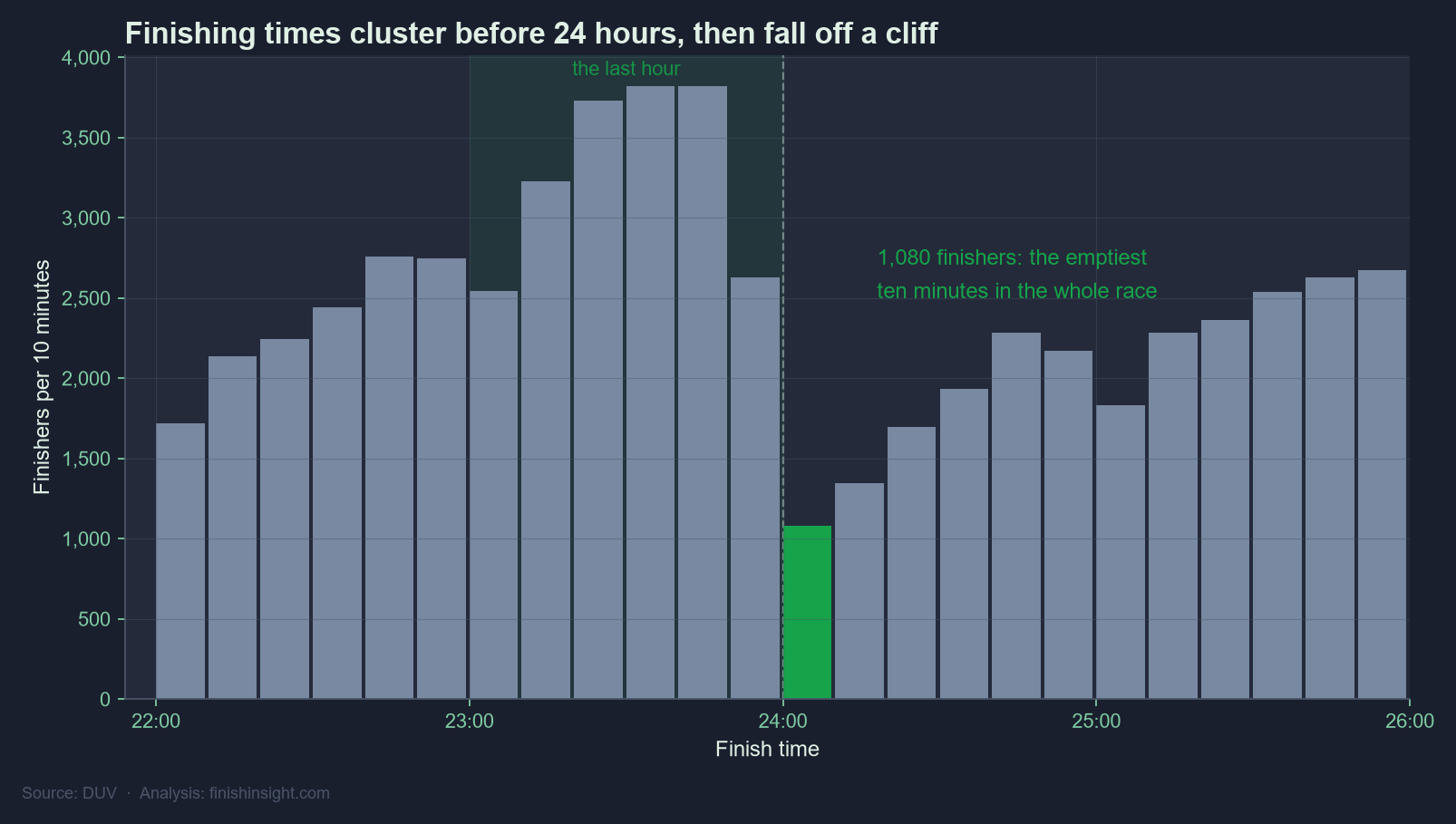
The data comes from DUV, finishers only, and it’s every 100 mile race that lets you carry on past 24 hours. Most give you 30, and plenty run to 32, 36 or 48 hour cutoffs. Almost everyone in that pile-up could have kept going and finished at 24:30 with no consequence at all. They chose not to.
The better objection took longer to rule out. Maybe every hour mark looks like this, and 24 only feels special because we expect it to. So we checked all of them.
At 23:00, finishing rates barely move. Same at 25, 26, 27, 28 and 29. Across ten ordinary hour marks, the ten minutes after each one carries between 72 and 95 per cent of the traffic of the ten minutes before. Hour marks are not, in general, interesting.
Two of them are. One is 24 hours. The other is 30.
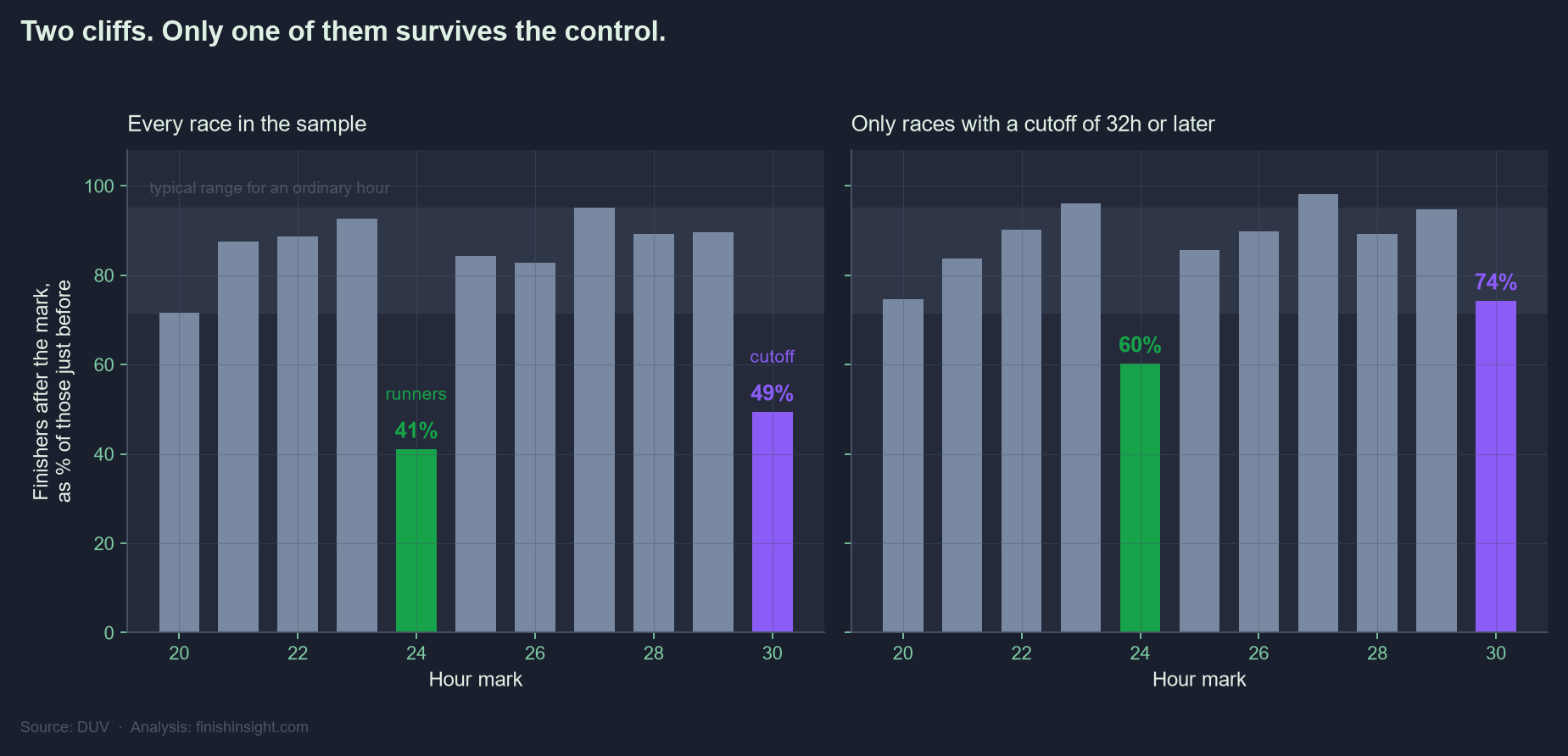
Thirty is the most common cutoff in a 100 miler: 1,044 of the races with a recorded cutoff end there. So the 30-hour cliff should be an artefact of the rules rather than anything runners are doing, and that is exactly what it turns out to be. Restrict the analysis to races with a cutoff of 32 hours or later, where neither number binds on anyone, and the 30-hour cliff mostly dissolves back into the ordinary range.
The 24-hour cliff does not. In races where nobody was stopped, where every runner in the sample was free to keep going, 40 per cent fewer people finished in the ten minutes after 24 hours than in the ten minutes before.
Two cliffs in the data. At one of them, a marshal is standing on the course with a clipboard. At the other, there is nothing at all.
The obvious gap is DNFs. Anyone who gave up when sub-24 slipped away doesn’t show up here at all. But if that were driving the cliff, everything after 24 hours would be thinned out. It isn’t. The hole is ten or twenty minutes wide and then the numbers climb straight back. People aren’t disappearing from the results. They’re arriving early.
The distribution has one more detail worth noticing. The peak sits at 23:30 to 23:50, not hard against the boundary. Nobody is timing it to the wire. Runners chasing this are building a buffer, and holding onto it, which means the pacing decisions that produce the cliff are being made hours out, not in the last mile. By the time you can see the finish, it has already been decided.
A hundred miles is a hundred miles at 23:58 and at 24:02, and the body does not know the difference. So what is it that makes 24 hours so alluring? The buckle, or the kudos of telling your mate at work you ran 100 miles and it only took a day.
Obviously the front of the pack will be chasing a goal several hours before the magic 24 but, for the mid-pack mere mortals that arbitrary number is worth everything.
Data from DUV, as at August 2026: 271,566 recorded finishes across 5,987 races between 159 and 163 km that permit finishing after 24 hours. Finishers only; DUV does not publish DNF data. Around 7% of finish times are recorded to the minute rather than the second. Counts will drift as new results are added.