Two countries, two completely different sports
An American ultra and a French ultra are very different events. In 2025 America staged 3,068 ultras and France staged 712. But the median American race had 24 finishers and the median French one had 130. More than half of American ultras had fewer than thirty people in them. In France it was fewer than one in five.
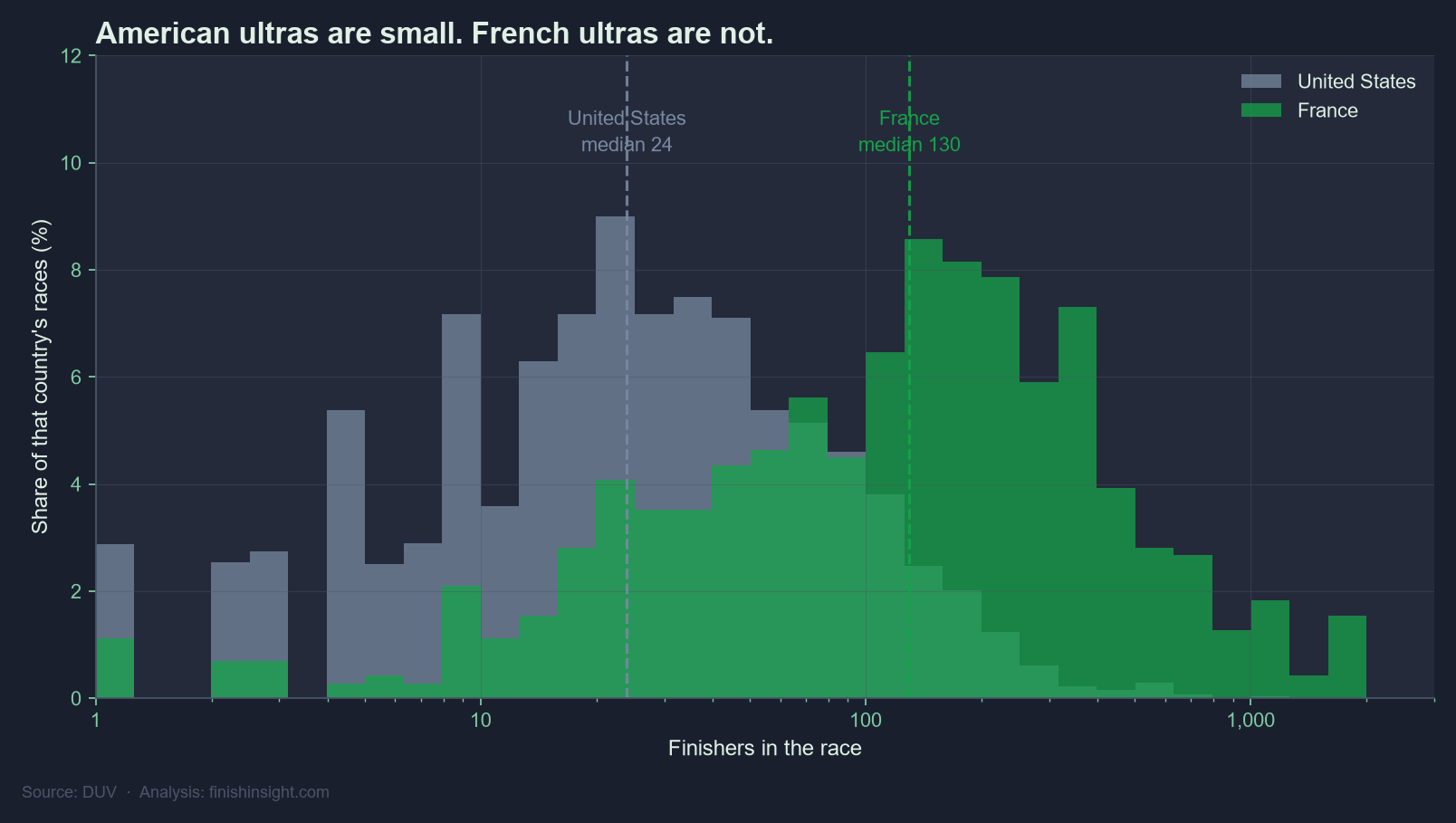
So America runs a great many small races and France runs a few enormous ones. Which means the thing you picture when you hear “ultramarathon” depends on which side of the Atlantic you learned the word.
The American version is a few dozen people at a trailhead at five in the morning, a folding table with crisps on it, and a race director who also marked the course. The French version is a start pen, a timing arch, and a thousand head torches winding up a hillside.
The distances differ too, and not slightly. One in ten American ultra finishes is at a hundred miles. In France it is one in a hundred.
That part matches the reputation. What does not is where the French volume actually goes. More French finishes come at 60 to 80 kilometres than at any other distance, and America has no equivalent of that at all. American racing sits on the round numbers instead, 50K and then a jump to a hundred miles.
Even the French landmarks refuse to be tidy. UTMB is 174 kilometres. Diagonale des Fous is 175. Neither is a number anyone chose, they are just how long it takes to get round the mountain.
There is no argument here about which is better. A thirty-person race in the woods and a two-thousand-person race in the Alps are both good days out, and plenty of people would prefer the first.
The point is narrower. When a race report, a training plan or a piece of advice travels between the two, it is often describing a sport the reader does not have. Aid station spacing, crew access, how long you spend alone, whether anyone is near you at 3am, what a mid-pack finish even means. None of it transfers cleanly.
Based on DUV data as at September 2026, covering all recorded finishes in 2025: 3,068 American races and 712 French ones. Field sizes are medians, so one very large event cannot move them.